


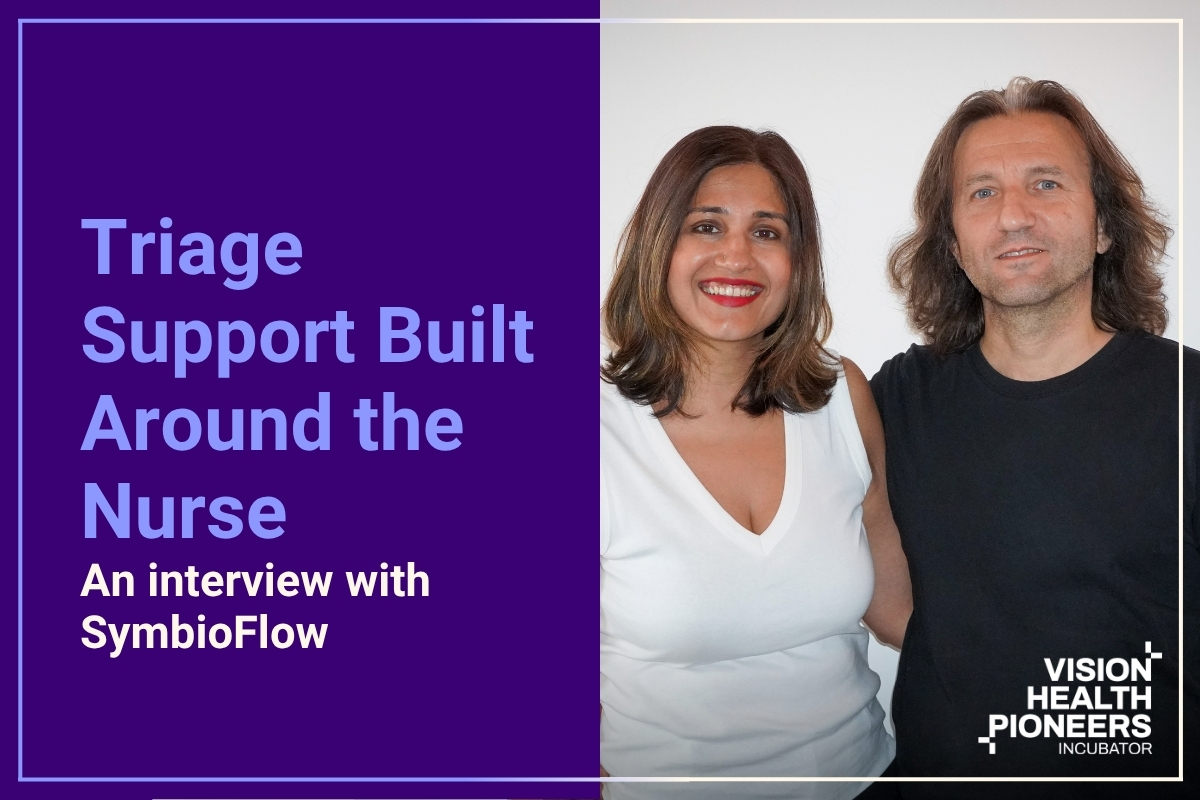
16 Sep MEET SYMBIOFLOW: A Co-Pilot for the Emergency Room
In most European emergency departments, the first assessment a patient receives still runs on a clipboard and a protocol booklet. One nurse, up to forty patients a shift, seconds to decide who is seen first and no support beyond their own training and judgement. SymbioFlow is trying to change what happens in those first minutes. Their system captures vital signs through a camera without touching the patient, gathers the intake history, and hands the nurse a draft priority to review. The clinical decision stays exactly where it is.
As part of Vision Health Pioneers Cohort 8, the team is currently validating that split at clinic and hospital test sites.
The AI never diagnoses and never decides acuity on its own. It captures vitals without contact using sensors and cameras. The nurse acts as a guard rail and always makes the final call. We are validating that split right now at our clinic and hospital testing sites.
What the system does is support the nurse in gathering the data she would otherwise collect manually in order to make a clinical decision. This is not about adding risk or another layer of tasks. It is about offloading the burden of the manual intake process, so that the time saved goes back into patient care.
Hybrid intelligence means the AI supports the nurse with the repetitive manual data collection. The product is designed to offer support, not independent decision making. Think of it as a co-pilot that assists the nurse with the day to day intake tasks in the emergency room, making the intake and routing of patients more efficient.
That matters more than it might sound. Around 60 percent of the traffic in any given German emergency room is patients with acute illnesses rather than emergencies.
Honestly, we do not fully understand why change is so slow and so bureaucratic in the German healthcare system, especially given how much the country invests in healthcare compared to other EU countries. So much of the system is still manual, right down to faxes and paper receipts.
What we did was act on a window of opportunity. The current German healthcare reforms, and the emergency care reforms in particular, have opened one. Why it took this long is a question healthcare professionals themselves are probably best placed to answer.
The biggest hurdle is a healthcare system that resists change, with a structure and a culture that make innovation difficult. The ongoing restructuring of the system complicates that further, because it also changes how proposals for change are received. Regulatory hurdles add another layer.
And capital tends to favour app based solutions, with all due respect to what those apps achieve.
Technical support on the software and hardware hybrid front, and introductions to the relevant stakeholders in the healthcare system, meaning hospitals and emergency medicine experts. Beyond that, expertise in medical hardware, and access to funding from portfolios that are open to long runways, that see regulatory frameworks as a moat rather than a barrier, and that are genuinely interested in hybrid solutions with the potential to transform how the system works.
SymbioFlow is taking on the harder version of this problem. Hardware and software together, in a setting where nothing ships without clinical validation, and where the people who would use it have every reason to be sceptical of anything new at the front door. Keeping the nurse at the centre of the decision is not a limitation of their approach. It is the point of it. We are looking forward to seeing how the validation work develops over the coming months.
Follow their journey here: https://symbioflow.ai/