



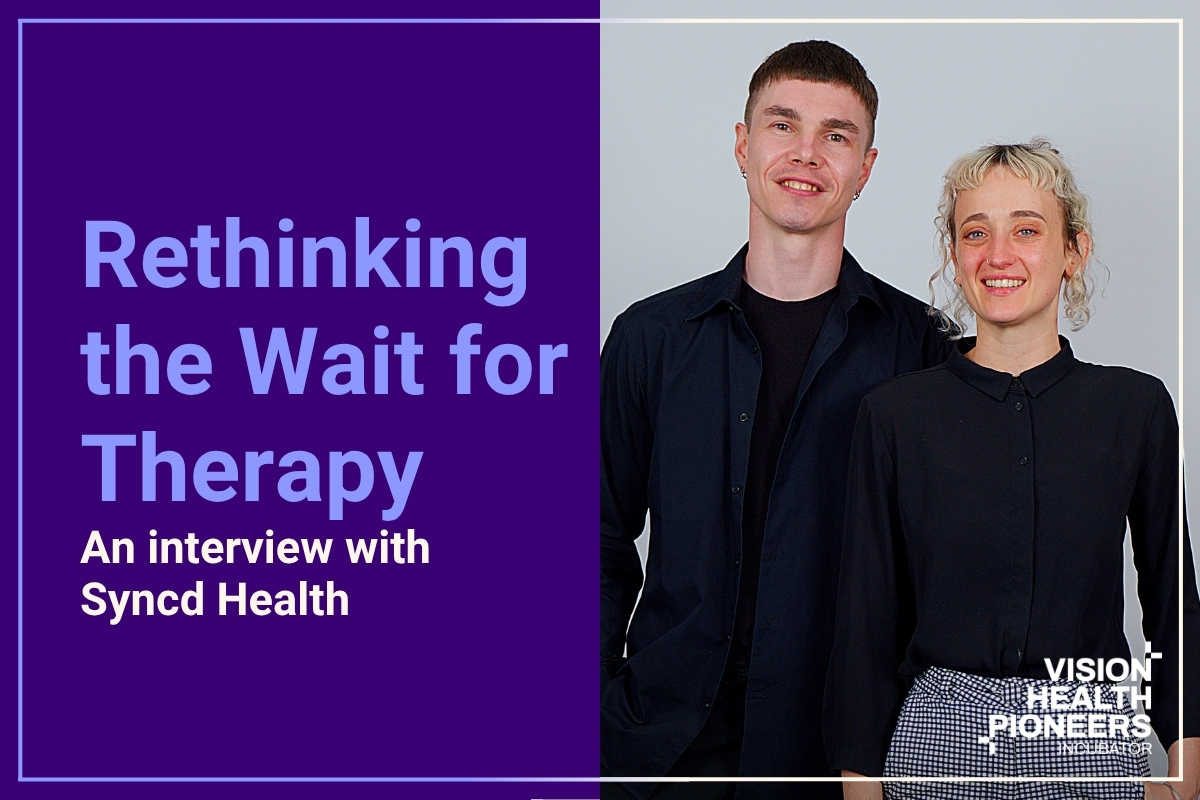
30 Jun Meet Syncd Health: Building Support for Germany’s Therapy Wait
Long waits for therapy aren’t just frustrating. In Germany, they’re a structural gap that leaves people without support exactly when they need it most. Amber and Ricki, co-founders of Syncd Health, know this gap firsthand. That’s what led them to build MAE, a companion for the average 142 days people in Germany spend waiting between their first consultation and the start of treatment. In this interview, Amber and Ricki share how their own experiences shaped the idea and what they’re hoping to get out of their time at Vision Health Pioneers.
We actually first came together as co-founders on a larger team building a social-emotional learning startup. That project eventually dissolved over team conflicts, which was a difficult and sad ending at the time. But in hindsight, something valuable came out of it: we realised how well we worked together.
That led us to explore a second idea together in reproductive health. After a few months, we recognised it wasn’t the right fit for us. So we stopped and did a deep dive into what we actually shared: our values, our frustrations and the problems we cared about. A belief that good mental health care shouldn’t depend on what you can afford. Frustration with a two-tiered, class-based system where people who can pay are seen quickly while everyone else waits. And an interest in problems that sit at the intersection of people and systems.
That is what led us to focus on supporting people going through the wait for therapy.
The problem feels close to both of us because we’ve lived versions of it ourselves. In 2025, when Amber was approaching burnout, she emailed 50 to 60 therapists as a foreigner on public insurance and couldn’t find a single open spot. When she looked into private care, she was told reimbursement was close to impossible. Ricki hit a different version of the same wall: paying out of pocket, an insurance rejection and switching insurers before finally being approved.
Our backgrounds, one in psychology and one in technology, turned out to be unexpectedly well matched to the problem.
To us, the system doesn’t fail people at the appointment itself. We’re genuinely glad German healthcare covers mental health care at all. But like many systems here, it works well on paper and becomes rigid and overly complex in practice. The failure happens earlier, in the 142 days, on average, that people spend waiting to get in.
The hardest part has been the business model and it’s specific to healthcare. The people we serve rely on publicly insured therapy. Anyone who can comfortably pay tends to go private and skip the public wait altogether, so the people left in the gap are those who can’t afford private therapy and are depending on the public system to come through for them. If we built a subscription app and charged a meaningful monthly fee, we’d price out exactly that group and they may be among the most vulnerable people in the system. That’s the opposite of what we’re trying to do.
So the mission has been fixed from the start: build it so the patient pays nothing or close to nothing. What keeps moving is the how. In the German system, “patient pays nothing” points toward reimbursement, where a health insurer covers the support rather than the individual and fitting a product to that path is genuinely hard.
We’ve had a working prototype for months. The real work now is shaping it into the specific version that a health insurer can actually reimburse and a pilot can actually prove. That has meant changing direction more than once and it probably will again. But each change has moved us closer to the same target, not away from it. For us that’s not a distraction from the mission. It is the mission, because who pays decides who gets access.
Hundreds of thousands of people enter this wait every year, and for most of them, support during those months looks like nothing. You get a diagnosis or a first consultation, you are told to find a therapist and then you are on your own. You send twenty, thirty or more emails, sit on waitlists and try to make sense of thirty pages of German paperwork. What stands out and we hear it in almost every interview, is that the effort peaks exactly when you have the least energy for it. People who are burned out are asked to run an administrative marathon and many give up.
Germany isn’t standing still though and there is a category of reimbursed digital health apps which a doctor can prescribe, known here as DiGA. They are a real step forward, but they treat a diagnosed condition rather than help you get into the system in the first place.
That is the gap we are building MAE for. It explains how the system works, including entitlements like the Sprechstunde and the 116177 line that most newcomers never hear about, helps you find and contact well-matched therapists, checks in on how you’re doing and, with your consent, can hand your future therapist a picture of the wait so you don’t start from zero. What is missing everywhere is continuity. Nobody owns this phase, and the months in between belong to no one.
We think it has gone unaddressed because the wait is nobody’s job. The German system is built around billable units of care. A therapist is paid for a session, an insurer pays for treatment that has been approved and the months in between, where someone has a diagnosis but no treatment yet, fall outside every billing category. Nobody is reimbursed for them, so structurally nobody builds for them. It is not that people do not care. It is that the incentives point everywhere except at the gap. The cost doesn’t disappear, though. It lands later, as lost work and heavier treatment and the lost-work cost alone runs to more than a billion euros a year.
The underlying shortage also keeps getting worse. Germany is short several thousand therapy seats; around half of practicing therapists are over fifty and the training path is long and expensive and the number of seats is capped, so supply is shrinking while demand rises.
Then there is the difficulty of the fix itself. Doing it properly means being a regulated product, securing a reimbursement pathway and generating real clinical evidence. That is a slow and expensive combination and it does not suit a fast consumer-startup model, which is why the well-funded consumer attempts struggled. We believe the only version of this that lasts is the regulated one, even though it is the harder road.
What we most want from the program is access to the parts of the healthcare ecosystem that are hard to reach from the outside. Building in regulated healthcare isn’t something you do alone in a room. It depends on relationships with insurers, clinicians and research institutions, and those relationships take years to build and an introduction to begin. The program sits inside that ecosystem and the connections and guidance it can offer, particularly on the reimbursement path and on designing real clinical evidence, are worth more to us at this stage than almost anything else.
Where we most want to be challenged is on our own assumptions. We’re close to this problem personally and that closeness is a strength for motivation but a risk for clear sight. We want mentors who will push on whether we’re solving the right slice of the problem, whether our model actually holds up and whether we’re moving faster than the evidence supports. We tend to want to fix quickly, sometimes too quickly, and the most useful thing a good mentor can do is slow us down and ask questions. We would rather be uncomfortable now than wrong later.
Syncd Health’s journey is just getting started. With a working prototype already in hand, Amber and Ricki’s next challenge is shaping MAE into something a health insurer can actually reimburse, so support during the wait doesn’t depend on what a patient can afford.
Follow their journey here: https://syncd.health/